Mechalogodrom Bible
The deep manual for the Cosmogonic Quantum Mechalogodrom — how to play,
simulate, read the HUD, and understand what every system is doing. This page complements
Docs (architecture) and Spec (technical sheet).
Current truth is anchored by the 22-report master/audit pair, the Tsotchke
22-external-repository depth ledger, and the explicit computational-indicator boundary for
the Consciousness and Sentience labs. Philosophy and contracts live in the repo under
docs/PHILOSOPHY-2026-06-26.md and
docs/MODULE-CONTRACTS-2026-06-26.md.
1. Getting started
Open the dome at /. The simulation runs in your browser via Bun + WebGL. Every run is seeded and deterministic: the same seed reproduces the same population trajectory. Reloading the page starts a fresh session for super-creature evolution, levels, and economy — nothing carries over from the last visit.
First five minutes
- Watch entities move, trade, split, and mutate in the arena.
- Open Telemetry (left) for population and chaos readouts.
- Try Sorting Fields — pick a field or hit AUTO to cycle every 2.5 seconds.
- Tap dock buttons: AI, HELP, NEURAL, ARCHITECT.
- Use ⛓ ACCESS when ready to unlock the playable super creature twin.
First 30 minutes
- Open ⚙ SETTINGS to access all simulation controls: pause, speed, split, burst, mutate, chaos, audio, render mode, view, space, weather, reset, apocalypse, singularity, NHI launch, chaos mode, and entropy.
- Press ⊞ NEURAL inside the Super Creature panel to open the 4-tab observatory (WORLD, COGNITION, QUANTUM, BRAIN).
- In the BRAIN tab, click ⬡ MEGA 4D to toggle the 4D tesseract connectome with 420 neurons across 5 cortical layers.
- Open ⟁ ARCHITECTURE to browse 101 super creatures and their breeding rites. The ⬡ MEGA 4D mode shows the apex brain live.
- Visit Lab for 36 WildBeyond tiles — strange attractors, reaction-diffusion, and quantum collapse fields.
- Visit Sentience for headless seed sweeps, null controls, ablations, and exportable consciousness-indicator telemetry.
2. Controls & dock
The bottom persist bar holds DOCS · SPEC · BIBLE · LAB, sim actions (⇄ ✦ ☢ ⚡), ACCESS, and ⚙ SET. All transport controls (PAUSE, RESET, SPEED, VIEW, SPACE) are now inside SETTINGS. Camera movement pads live in Settings and on touch overlays (joystick + look pad). Keyboard: WASD move, QE vertical, arrows rotate, Space burst, Shift split, M mutate, Tab chaos boost.
Settings (⚙ SET)
Audio, render mode, view, weather, pause, time scale, reset, apocalypse, singularity, NHI launch, and chaos mode. Split / Burst / Mutate / Chaos moved here from the old control panel to save HUD space.
3. The living world
Up to 50,000 organisms across phyla morphotypes, titans, economy agents, weather, and chaos fields. Entities use real seeded math — colors are quint-prime hashed for thousands of saturated variations. The Mechalogodrom center monster, Archon pantheons, and NHSI faculties read and write shared world state.
4. Super creature & ACCESS
Solving the access puzzle unlocks superhero mode: you become the second super creature. The twin HUD shows life, energy, XP, wallet, neural emotion, powers, and pilot/camera modes. Brains: letter creatures ~25,000 parameters each; APEX #101 starts at 100,000 parameters scaling toward millions — alien, non-earth morphologies documented in the repo MD corpus.
5. 100-letter dome & APEX
The Latin/Greek/Roman alphabet pantheon (100 glyphs + APEX #101) orbits the dome as a visual swarm. Breeding rites no longer wire into petri growth — they exist, glow, and evolve visually until backend coupling returns. The APEX abomination is the capstone visual entity.
6. Sorting fields
Twenty-five algorithms sort entities by different keys (energy, age, hue, etc.). Modes:
- Single — one field at a time; click rows to switch.
- ALL — every field active; progress bars pulse together.
- AUTO — advances to the next field every 2.5 sim-seconds; readout shows countdown. This is a real batched sort — each field runs its own comparator over the live entity array and the progress bar tracks the sort pass.
7. Neural / Architect / NHSI
The center HUD cycles AI copilot, HELP, audit log, NHSI neural observatory, market, architect panels, and the 101-creature architecture pantheon cycler. Connectome and brain composites are functional correlates — scaffolding for measurement, not claims of sentience.
Neural Observatory (IV · BRAIN tab)
The BRAIN tab has a cycle button that toggles between two visualizations:
- COMPOSITE — the original 3D connectome showing the mind's organs (loom, acoustic, necro, quantum, etc.) with signal flow arrows and labeled nodes.
-
MEGA GODLIKE 4D — a 4D tesseract connectome with 420 neurons
distributed on a rotating 4D hypersphere, projected through x-w / y-w / x-y rotations
into 3D. Features:
- Tesseract skeleton (16 vertices, 32 edges) as the spacetime scaffolding
- Per-neuron organ coloring (30 organs, each its own hue family)
- Axonal connections by 4D Hamming distance with traveling spike pulses
- Dendritic shimmer rings and soma cores sized by activity
- Global broadcast wavefront when consciousness is high
-
Activity driven by real
SuperMindSnapshotlatent + quantum + consciousness fields
NHSI faculties
The Neural Hierarchy Super-Intelligence is a 100-faculty pantheon + 25 theory-of-mind
organs. All 100 are instantiated and stepped each beat, but that is the DESIGN count, not
a wiring claim: roughly 30 are genuinely deep-wired into the apex
think() (each reads world state AND moves the plan, drives, or
consciousness). The remaining ~70 act as a generic-profile bias bank. The system is a
functional correlate architecture — it models cognition, not phenomenal consciousness.
8. Labs
The Lab artifact runs 36 WEBGL tiles across three boards: collapse fields, attractors (Lorenz, Rössler, Thomas, …), reaction–diffusion, Voronoi, and curl-noise flows. Tap tiles to pulse; page keys switch boards. Mobile tiles use pulled-back cameras so attractors stay framed.
The Consciousness Lab is the first evidence dashboard:
entity adapters, ten-framework heatmaps, null separation, ablation receipts, and a tracked
consciousness-data.json feed.
The Sentience Lab is the second evidence dashboard: no Dome
renderer, just 32 deterministic headless seeds, convergence/reward control gaps, framework
load, entity telemetry traces, and CSV/JSON exports from sentience-data.json.
It is for report analysis and AI-readable evidence, not a claim of phenomenal sentience.
The 36 tiles
- Board 1 — Collapse: Born-rule measurement fields, quantum decoherence visualizations, wavefront interference patterns.
- Board 2 — Attractors: Lorenz (butterfly), Rössler (single scroll), Thomas (double scroll), Aizawa, Chen, and Newton–Leipnik strange attractors — each rendered as 3D particle trails.
- Board 3 — Fields: Gray–Scott reaction–diffusion, Voronoi tessellation, curl-noise advection, and hybrid quantum–classical flow fields.
Controls
- Sliders: particle count, collapse rate, base speed, ring speed.
- Tap: pulse a tile's hot state (brightens + quickens).
- Page Up/Down: switch boards.
- Mobile: pinch to zoom, drag to orbit; attractor tiles auto-frame.
9. Philosophy & vision
Canonical capability standard
CQM-25, framework version 1.0.0, is the project's binding capability profile for individual beings, populations and constructed worlds. Its 25 axes connect definitions to measurements, controls, falsifiers and evidence. Ecology is one domain among several; physics is assessed against declared rules. Adoption is project policy, with scientific acceptance experiments and score calibration still to be completed. Provisional author estimates are available separately with their heuristic rubric and submitted rationale; they are not measured benchmark results.
What this is
Deterministic multi-caste xeno-dome: 60k edible flora, waste→fertilizer ecology, multi-tier predation, dual economies + game theory, multi-scale neural control (70p swarms → ~10k SuperMinds), mind-driven morphing bodies, weather-coupled climate — indicator-only consciousness stack. Historical A-Life survey breadth #1/155 (3.80 code-grounded) on the internal 9-axis survey, retained as comparison context. Solo indie research dome: up to 50,000 organisms at mega tier (10k default). Seeded simulation core is not an LLM; optional Copilot is a read-only shell fenced out of deterministic state.
What it is not
- Not sentient — the mind models are functional correlates, not phenomenal consciousness (Butlin 8/14 met + 6/14 partial; lab headline index fails null discrimination; coupling ~0.27).
- Not a QPU, not physical entropy, not a CSPRNG claim — classical statevector / facades.
- The seeded core performs no language-model inference; optional Copilot text generation is structurally fenced outside the simulation.
- Not Avida OEE, not Sims body-plan evo, not Polyworld long-horizon coevo — specialist pins remain; peer maturity 1.5/5.
- Not a game in the traditional sense — it is a research instrument you can watch and influence.
Determinism as a design principle
Every random draw in the simulation uses a seeded Rng (mulberry32). No
Math.random exists in sim logic. The same seed produces the same population
trajectory byte-for-byte. This is essential for reproducibility and scientific
defensibility.
Tsotchke quantum corpus
The Tsotchke corpus is a mixed, ledgered integration: 8 deep, 7 wired, 2 harvest, 4 fenced, and 1 metadata repository; 17 of 21 non-meta repositories affect runtime behavior. Direct ports, deterministic adaptations/facades, and inert provenance fences are distinguished explicitly rather than described as blanket gate-for-gate parity. Quantum paths run as deterministic classical statevector or related simulations, not on a physical QPU.
Inspirations
- Stephen Thaler's Creativity Machine (generator + perceptor)
- Karl Friston's Free Energy Principle / Active Inference
- Global Workspace Theory (Baars / Dehaene)
- Integrated Information Theory (Tononi — Φ)
- ALife / digital biologics tradition (Ray, Holland, Yaeger)
- Quantum computing gate-model formalism (Nielsen & Chuang)
- Strange attractors (Lorenz, Rössler, Thomas)
- Gray–Scott reaction–diffusion systems
10. Glossary & terminology
- Active Inference
-
Friston's framework — agents minimize free energy by updating beliefs and acting to
match predictions. Implemented in
src/sim/active-inference.ts. - ALGO_AUTO_PERIOD
-
Seconds the sorting-field AUTO mode dwells on each field before advancing. Currently 6
seconds (
ALGO_AUTO_PERIODinsrc/world.ts). - Alphabet Pantheon
- 100 Greek + Latin + Roman letter archetypes rendered as instanced meshes in the dome sky. Visual-only — no physics, no AI, no economy.
- APEX
- Entity #101 — hyper-chromatic capstone above the 100-letter pantheon. 100k-parameter brain baseline scaling toward 5M. Visual-only for now.
- Archon
- One of 5 Super Creatures (godforms) with full mind + body + economy wiring. Distinct from the 100 letter creatures.
- Atom of Thought
- Each organ-net processes a 4-dim slice of the latent — the smallest unit of the composite mind's reasoning.
- Born Rule
- Quantum measurement postulate: probability = |amplitude|². Used in WildBeyond collapse tiles and super-qubit thought collapse.
- Chaos Mode
- Lorenz-driven quantum storm engaged via settings or hotkey K. Quickens the pantheon, intensifies visuals.
- Connectome
- The wiring diagram of the super creature's mind — 30 organs + signal flow paths. Visualized in the BRAIN tab.
- Cortex
- The perception sub-network: 18 senses → 32 hidden → 16-d latent. The first stage of the 5-stage cognitive pipeline.
- Creativity Machine
- Thaler's architecture: a generator network perturbed by noise + a perceptor critic that scores novelty. Implemented as IMAGITRON + PERCEPTOR.
- Determinism / Rng
-
All sim randomness uses seeded
Rng(mulberry32); noMath.randomin sim logic. Same seed ⇒ identical trajectory. - Digital Biologics
- The Tsotchke-pioneered approach to modeling biological processes digitally — wired into entity life cycles, mortality, and evolution.
- Eshkol
- The qubit-RNG system — a real quantum randomness simulation ported from the Tsotchke corpus. Used for thought collapse salience.
- Free Energy
- Friston's variational free energy — the surprise between prediction and observation. Tracked as a live readout in the cognition tab.
- Global Workspace (GNW)
- Baars/Dehaene's theory — a broadcast space where winning coalitions of processors ignite. Implemented as the ignition readout.
- Gray–Scott
- Reaction–diffusion system producing spot/stripe patterns. One of the 36 WildBeyond tiles.
- Holographic Memory
-
A distributed associative memory system — each memory stored across the entire weight
matrix. Implemented in
src/sim/holographic-memory.ts. - Imagitron
- The Creativity Machine generator: (latent ⊕ noise) → imagined latent. 24 → 32 → 16.
- Integrated Information (Φ)
- Tononi's IIT — a measure of how much a system is "more than the sum of its parts." Tracked as the phi readout.
- Lorenz Attractor
- The butterfly-shaped strange attractor from the 1963 weather-convection equations. One of the 36 WildBeyond tiles.
- MEGA GODLIKE BRAIN
- The 4D tesseract connectome visualization — 240 neurons on a rotating 4D hypersphere with five frequency layers (δ–γ), axonal pulses, dendritic halos, spike-train traces, and a global broadcast wavefront. Toggle via ⟁ COMPOSITE / ⬡ MEGA 4D in Neural tab IV · BRAIN or ⬡ MEGA 4D in ⟁ ARCHITECTURE.
- Mechalogodrom
- The central arena organism and namesake simulation dome. 10 bipolar titan shells converge + fuse into one monster.
- Mind Field
-
The spatial substrate where cognitive operations happen — a 2D field model in
src/sim/mind-field.ts. - Mulberry32
- The specific PRNG algorithm used for all sim randomness. Fast, deterministic, good distribution.
- NHSI
-
Neural Hierarchy Super-Intelligence — 100-faculty pantheon + 25 theory-of-mind organs.
100 is the design count (all instantiated and stepped); ~30 faculties are deep-wired
into the apex
think(). - NHI
- Non-Human Intelligence — dynamically launched, bounded-population super-minds that READ the world and WRITE to it (ordinary minions, targeted manipulation/domination, hunt, mimic, retreat, and broadcast). These are distinct from the five fixed Archon/Super Creature minds.
- Noosphere
-
The sphere of human thought — modeled as a collective field in
src/sim/noosphere.ts. - Open-Endedness
-
Bedau/Packard metrics for whether the system keeps producing novel, interesting
behavior. Tracked in
src/sim/open-endedness.ts. - Perceptor
- The Creativity Machine critic: scores imagined latents for novelty. 16 → 20 → 4.
- Petri Dish
- Each super creature has a petri dish — a sub-ecology of organisms that grow and evolve around it.
- Quantum Reservoir
- A quantum-enhanced reservoir computing layer — uses quantum states as a computational substrate for temporal processing.
- Rössler Attractor
- A single-scroll strange attractor (1976). One of the 36 WildBeyond tiles.
- Spin Glass
- A disordered magnetic system modeled as a Hopfield/Ising lattice — the INSTINCT readout in the cognition tab. Ported from the Tsotchke corpus.
- Statevector
- The full quantum state of a system — a complex vector of 2^n amplitudes for n qubits. Simulated exactly on classical silicon.
- Super Creature
- The player-controllable entity with a ~10k-parameter composite mind, twin HUD, and superhero mode. Unlocked via ACCESS.
- SuperMindSnapshot
- The read-only telemetry struct pushed to the neural observatory each beat — contains latent, quantum, consciousness, emotion, plan, and param count.
- Theory of Mind (ToM)
- The ability to model another agent's mental state. 25-organ ensemble in the NHSI.
- Thomas Attractor
- A double-scroll strange attractor. One of the 36 WildBeyond tiles.
- Tree of Thought
- 5 depths × 5 variants = 25 imagined branches; the best branch is kept each depth. The IMAGINE stage's search strategy.
- Tsotchke
- Mixed, ledgered corpus integration: direct ports, deterministic adaptations/facades, harvest/tooling roles, and inert fences at declared depths. Quantum paths execute on classical silicon, not a physical QPU; no blanket gate-for-gate parity is claimed.
- WildBeyond
- Standalone p5 lab blending Lorenz collapse, Born-rule measurement, and 36 mathematical tiles across 3 boards.
- ACCESS
- Cryptographic puzzle terminal; unlocks playable super creature + twin HUD.
- Active Inference
-
Friston's framework — agents minimize free energy by updating beliefs and acting to
match predictions. Implemented in
src/sim/active-inference.ts. - Architect Panel
- The ⟁ ARCHITECTURE panel — 101 super creatures + brood + the apex ς Quantum Brain. Cycles through ATTRACTOR, WINDING, BLASCHKE, and ⬡ MEGA 4D visualization modes.
- Biomechanical
- NHI body aesthetic — dark metallic surfaces with red emissive glows, morphing geometry, and pulsing animations. Not organic — alien machine-life.
- Bloch Vector
- A 3D unit vector representing a single qubit's state on the Bloch sphere. Visualized in the QUANTUM tab of the neural observatory.
- Center HUD
-
The central panel slot that cycles through AI, HELP, AUDIT, NEURAL, MARKET, ARCHITECT,
and ARCHITECTURE panels. Uses
!importantCSS to re-home panels into a centered slot between the side columns. - Chaos Boost
- A temporary injection of entropy into the simulation — entities scatter, colors shift, and the pantheon quickens. Triggered via the ⚡ CHAOS button or hotkey Tab.
- Consciousness Indicators
- 21 tracked indicators: the canonical Butlin 14 plus 7 Foundationals extensions. Standing against the Butlin rubric is 8/14 met + 6/14 partial — never read the 21 as 21 Butlin indicators, and never as 14/14. They track computational correlates of consciousness (global integration, attention, prediction, embodiment). Not claims of phenomenal consciousness — functional correlates only.
- Cortical Layers
- The 5 frequency bands in the MEGA GODLIKE BRAIN: δ (delta), θ (theta), α (alpha), β (beta), γ (gamma). Each layer's neurons spike at different frequencies, mirroring real cortical oscillation bands.
- Curiosity Drive
- An intrinsic motivation signal — entities with high curiosity explore more, seek novelty, and drive open-endedness. Tracked as a live readout.
- Dome
-
The main simulation arena — a circular world of radius
ARENA_RADIUSwhere entities live, trade, and evolve. The alphabet pantheon orbits the upper dome. - Economy
- Two currencies + two commodities: Aurum (☉), Umbra (☾), Quanta (◇), Ichor (❖). Entities trade via proximity-based market agents. The super creature's wallet tracks all four.
- Emergence
- When simple local rules produce complex global behavior — the core principle of A-Life. The Mechalogodrom is designed to maximize emergent novelty.
- Entropy Boost
- The bipolar opposite of chaos — raises the order/heat-death axis. Triggered via the 🔥 ENTROPY button in settings.
- Foundationals
- The consciousness architecture layer — 21 indicators (Butlin 14 + 7 extensions, standing 8/14 met + 6/14 partial), a 1B-neuron self-awareness ROADMAP TARGET (not a built count), and the Mechalogodrom brain fusion mind. Implements indicators from Butlin's computational correlates framework; meeting an indicator is not consciousness.
- Genealogy
- The lineage tree of super creatures — 101 archetypes from COMMON to FORBIDDEN rarity, each with unique genome, bias, and quantum signature.
- Genome
- The heritable trait vector of each entity — controls behavior, appearance, and metabolic properties. Passed to offspring with mutation during splitting.
- Glyph Brain
- The 25,000-parameter neural network inside each of the 100 letter creatures. Drives motor outputs, activity, novelty, and valence — all visualized in the dome.
- Hotkey
- Keyboard shortcut: WASD move, QE vertical, arrows rotate, Space burst, Shift split, M mutate, Tab chaos, K chaos mode, N NHI launch, H help, G singularity.
- Instinct (Spin Glass)
- The Hopfield/Ising lattice — a disordered magnetic system that serves as the super creature's instinctual drive. Ported from the Tsotchke corpus.
- Latent Space
- The 16-dimensional internal representation of the super creature's mind — the workspace where perception, imagination, and reasoning operate.
- Mind Field
-
The spatial substrate where cognitive operations happen — a 2D field model in
src/sim/mind-field.ts. - Morphotype
- The geometric body type of an entity — icosahedron, octahedron, dodecahedron, tetrahedron, or torus-knot. Determined by phylum and letter identity.
- Necro
- One of the 30 mind organs — handles decay, mortality, and regeneration signals. Part of the composite connectome.
- Noosphere
-
The sphere of human thought — modeled as a collective field in
src/sim/noosphere.ts. - Open-Endedness
-
Bedau/Packard metrics for whether the system keeps producing novel, interesting
behavior. Tracked in
src/sim/open-endedness.ts. - Organ
- A functional sub-network of the composite mind — 30 organs, each processing a 4-dimensional slice of the latent. Examples: CORTEX, IMAGITRON, PERCEPTOR, NECRO, QUANTUM, DRIVE, SELF.
- Petri Dish
- Each super creature has a petri dish — a sub-ecology of organisms that grow and evolve around it.
- Phylum
- The taxonomic group of an entity — determines geometry family, behavior pool, and hue band. Entities inherit phylum from their parent during splitting.
- Quantum Coherence
- A measure of how quantum-mechanically correlated the super creature's mind is. High coherence means the qubits are in a coherent superposition state.
- Quantum Reservoir
- A quantum-enhanced reservoir computing layer — uses quantum states as a computational substrate for temporal processing.
- Render Mode
- The entity visual style: SOLID (default), WIRE (wireframe), POINT (point cloud), NIGHT (inverted colors). Cycled via the ◐ RENDER button in settings.
- Rite
- The breeding ceremony in the Architecture panel — two creatures are mated using game-theory payoff matrices to produce offspring in the brood.
- Super Creature
- The player-controllable entity with a ~10k-parameter composite mind, twin HUD, and superhero mode. Unlocked via ACCESS.
- SuperMindSnapshot
- The read-only telemetry struct pushed to the neural observatory each beat — contains latent, quantum, consciousness, emotion, plan, and param count.
- Tesseract
- A 4D hypercube — the geometric scaffold of the MEGA GODLIKE BRAIN. 16 vertices, 32 edges, projected through x-w and y-w rotations into 3D.
- Theory of Mind (ToM)
- The ability to model another agent's mental state. 25-organ ensemble in the NHSI.
- Thomas Attractor
- A double-scroll strange attractor. One of the 36 WildBeyond tiles.
- Titan
- One of 10 bipolar titan shells that converge and fuse into the Mechalogodrom — the central arena organism.
- Tree of Thought
- 5 depths × 5 variants = 25 imagined branches; the best branch is kept each depth. The IMAGINE stage's search strategy.
- Tsotchke
- Mixed, ledgered corpus integration: direct ports, deterministic adaptations/facades, harvest/tooling roles, and inert fences at declared depths. Quantum paths execute on classical silicon, not a physical QPU; no blanket gate-for-gate parity is claimed.
- View Mode
- Camera perspective: ORBIT (third-person orbit), 3RD (fixed third-person), 1ST (first-person through the super creature's eyes). Cycled via the 👁 VIEW button.
- Weather
- Environmental conditions affecting entity behavior: CLEAR, STORM, FOG, AURORA, SINGULARITY. Cycled via the ☁ WEATHER button in settings.
- WildBeyond
- Standalone p5 lab blending Lorenz collapse, Born-rule measurement, and 36 mathematical tiles across 3 boards.
- Wolfpack
- A cooperative hunting behavior — entities in a wolfpack coordinate to pursue prey. One of several emergent behaviors in the simulation.
11. Repo MD corpus guide
The docs/ directory contains the full research corpus. Master index:
BOOK-2026-06-26.md. Generated from BOOK tables (run
bun scripts/gen-bible-corpus.ts after BOOK edits):
Start
- BOOK — master RAG index
- Superset index over every doc and module.
- RUNBOOK — ops & smoke
- Bootstrap, gate, deploy.
- AUDIT-LOG.md
- Centralized audit history (newest-first).
- PHILOSOPHY-2026-06-26.md
- The aesthetic constitution: real math under every effect; every system reads AND writes another. **+ Tsotchke biologics paradigm.**
- CONTROLS-2026-06-26.md
- Every key, button, and gesture.
- TECHNICAL-SPECIFICATION-2026-06-26.md
- The full technical spec sheet (also at `/spec`). **Updated with Tsotchke corpus, soup, sentience metrics.**
Architecture
- FILE-MAP — auto module map
- All src modules summarised from headers.
- APEX brain parameter scale
- 25k glyph · 100k→5M apex · Mechalogodrom roadmap.
- ARCHITECTURE-2026-06-26.md
- The layered system architecture + frame pipeline.
- MODULE-CONTRACTS-2026-06-26.md
- The binding per-module spec (V1 + V2) — contract wins over any writer.
- COMPLEXITY-2026-06-26.md
- Big-O of the hot paths.
- ENTITY-SHEETS-2026-06-26.md
- The bestiary: biology / behaviour / silhouette / material / animation / world-meaning / economic-role for every class — entities, Shoggoths, Puppeteers, Titans, NHIs, the **SUPER CREATURE** (§5★), Leviathans, singularities, tribes, market agents.
World
- ADR-0005 math stack
- Why these math libraries / techniques.
- AI-SUBSYSTEM-2026-06-26.md
- Pre-transformer technique index + live Copilot wiring.
- BENCHMARKS-2026-06-26.md
- Measured hot-path costs (the PHYSICIST's law: measure, don't guess).
Research
- AUDIT-LOG — living audit trail
- Newest-first audit entries.
- CONSOLIDATED-22-MASTER-ASSESSMENT — current master
- Current 22-report synthesis: what is relevant, stale, defensible, and still missing.
- CONSOLIDATED-22-FILE-AUDIT — trust ledger
- File-by-file audit of the 22 report artifacts and publication-surface gaps.
- KANBAN — in-flight work
- Live task board.
- VENTURES — product horizon
- Multiplayer, accounts, outreach (aspirational).
- UI-UX-DEEP-DIVE-AUDIT — UI/UX backlog
- Living plan for HUD, brain viz, pantheon, BIBLE depth.
- PEER-REVIEW META-ANALYSIS — falsifiable defense
- 500-point academic framework vs A-Life field.
- AI-SUBSYSTEM-2026-06-26.md
- The Copilot architecture + safety posture.
- COPILOT-PROVIDERS-2026-06-26.md
- The failover provider chain + the offline 🩺 diagnostics.
- `src/ui/help-knowledge.ts`
- The repo-grounded HELP corpus + retriever (the in-world RAG; safety constitution baked in).
- DESIGN-SYSTEM-2026-06-26.md
- Tokens, typography, the glass aesthetic.
- ENTITY-SCHEMA-AND-MAPPINGS-2026-06-26.md
- Consolidated ERD / ERM / ERP source of truth.
- RISK-REGISTER-2026-07-02.md
- Consolidated threat table (likelihood × impact, mitigation, residual).
- VERIFICATION-ANALYTICAL-DATA.md
- Test taxonomy, receipts law, coverage goals, known edges.
- BENCHMARKS-2026-06-26.md
- Frame-budget measurements and hot-path performance truth.
- SECURITY-ARCHITECTURE-2026-07-02.md
- Threat model + hardening posture for a static, no-backend artifact.
- ../THIRD-PARTY-NOTICES.md
- Dependency notices and supply-chain attribution.
- `scripts/reproduce.ts`
- One-command third-party replication (determinism fingerprint + coupling).
- ../CHANGELOG.md
- Every increment, V1 → today, with verification receipts.
- 500-POINT-INSPECTION-2026-06-26.md
- The deep inspection checklist.
- BRAIN-NEUROLOGY-CONSCIOUSNESS-ENGINEERING-ASSESSMENT-2026-07-06.md
- Deep canonical brain/neuro/consciousness assessment: 4 AI reports merged, SSOT reconciliation, Butlin indicators, Thaler markers, academic scrutiny.
- NHSI-PROGRESS-DASHBOARD-2026-06-26.md
- Canonical NHSI scorecard: 100-faculty design, 25 Archons, 25 ToM organs, 10 emergence angles, Tsotchke depth, Butlin 8/14 met + 6/14 partial.
12. Mission & roadmap
Current state
- 295,227 tracked authored lines: 218,578 TypeScript lines plus docs, lab pages, data, native C/C++ headers/sources, and generated/static artifacts.
- Up to 50,000 agents (10,000 at 60 fps on integrated graphics)
- Exact tracked receipt: 3,631 tests, zero failures.
- Portable coverage floor: 84.64% line / 82.21% func.
- Latest Windows measurement: 3,297 tests, zero failures, 3,589,864 assertions, 93.60% line / 91.61% function across 366 test files.
- 5 Super Creatures with full mind + body + economy wiring
- 100 letter creatures with 25k-parameter glyph brains — visually alive, orbiting, drifting, and pulsing
- APEX #101 abomination — 100k-parameter brain scaling toward 5M, alien capstone entity
- Neural IV BRAIN visualization — 420 neurons, 5 cortical layers, spike rings, dendritic halos; the separate Architecture viewer uses 320 neurons
- 36-tile Quantum WildBeyond lab — Lorenz, Rössler, Thomas, Aizawa, Chen, Newton-Leipnik, Gray-Scott, Voronoi, curl-noise
- Tsotchke corpus — Eshkol qubit-RNG, QGTL geometry, spin-glass instinct, and the wider 8-deep / 7-wired / 2-harvest / 4-fenced / 1-meta ledger, without blanket parity claims
- Dome ecology verification — Xenomimic tether removal, canonical tree food, sanctuary rules, temporary visits, social cleanup, performance, and browser evidence
-
Operational organism-intelligence V3 causal receipt
·
machine-readable evidence: the fixed, V1/V2-disjoint 30-seed synthetic
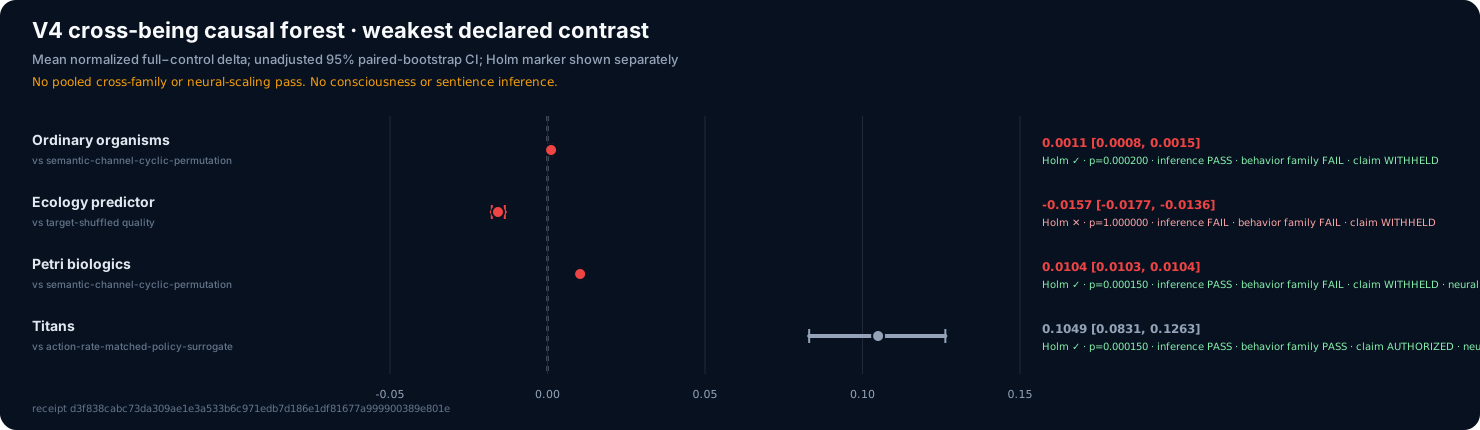
+xgoal evaluation passes the goal-controller, corpus-conditioned goal-response, reversal-adaptation, 17-integrated-repository causality, numerical-safety, 10/10 consumer-counterfactual, and three-process/30-batch performance gates. Uniform random-action and aggregate/surrogate specificity controls do not separate, so it grants no numeric A-Life-score uplift and is indicator-only—not consciousness, sentience, or quantum evidence. - Repository-preregistered V4 Phase-A descendant · JSON receipt · 1,152-row CSV · failure-forward forest: ordinary and Petri pass inference but miss the frozen magnitude floor, the adaptive predictor loses to both controls, and Titans alone pass. The only authorized claim is bounded Titan game-policy semantic causality; no neural scaling, pooled result, numeric score, consciousness, or sentience uplift follows.
Planned milestones
- GPU shader brain: 25k params per letter creature, 100k→5M for APEX
- Full-stack deployment: browser + mobile + tablet, Windows/Mac/Linux
- Multiplayer: up to 10 simultaneous global players
- User accounts: contact info, donations, in-game purchases
- Subscriptions: $10/mo early access + 10 min personal meeting; $5 EDU/non-profit
- Free AI resources: models, learning links, library resources for all players
- Peer-review meta-analysis: defensible, falsifiable study of the simulation
- Institution outreach: labs, professors, engineers, scientists, foundations
- APEX scaling: 100k → 250k → 500k → 1M → 2.5M → 5M parameters
Funding vision
Solo indie bootstrap dev, self-taught, no degree, no resume in tech. Goal: secure funding or a potential exit/offer through A-Life research. The simulation is designed for falsifiable comparison against the published 155-system matrix; independent peer review has not yet been obtained.
See docs/NHSI-PROGRESS-DASHBOARD-2026-06-26.md for measured progress
receipts.
13. Ventures & beyond
The core sim stays deterministic and local. The Ventures horizon describes future layers: hosted deploy, waitlist, up to 10-player multiplayer, subscriptions ($10 early / $5 EDU), institution outreach, and a peer-review meta-analysis study.
-
Waitlist —
POST /api/waitlistwith{ "email": "…" }(scaffold). -
Roadmap JSON —
GET /api/venturesreturns milestone summary. - Social amplify — GitHub star / follow / repost helps grow the A-Life community.